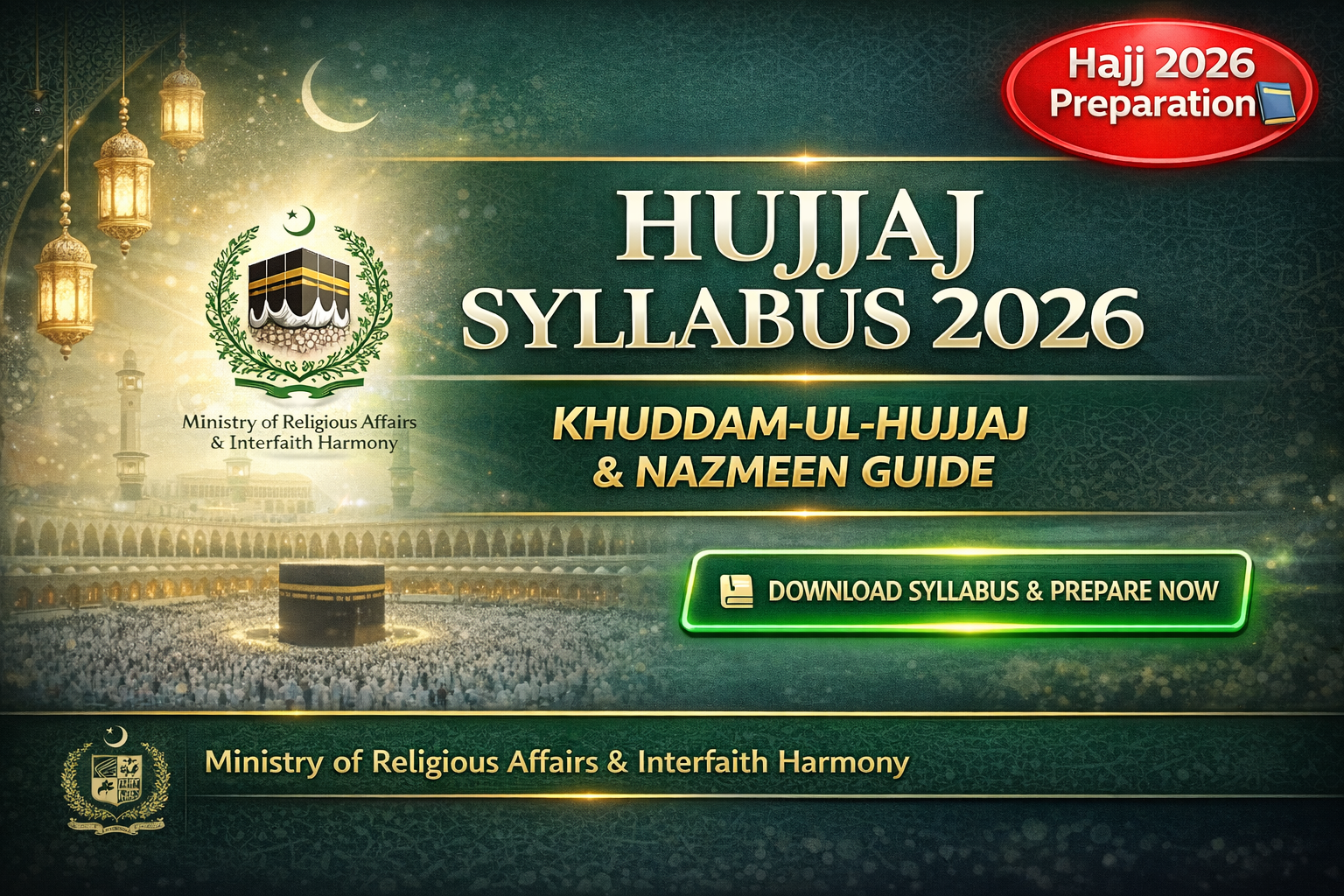
Download and study the official Khuddam‑ul‑Hujjaj & Nazmeen Syllabus 2026. Covers Islamic studies, Hajj rituals, management, GK, English, computer skills, aptitude, and psychological assessment.
The Ministry of Religious Affairs and Interfaith Harmony (MORA), in collaboration with NTS, has released the official syllabus for Khuddam‑ul‑Hujjaj and Nazmeen recruitment 2026. Civil servants from BPS‑11 to BPS‑18 can apply to serve as facilitators during Hajj 2026.

This syllabus ensures that selected staff are well‑trained in Islamic knowledge, Hajj rituals, management, communication, and digital skills to assist pilgrims effectively.
Overview – Khuddam‑ul‑Hujjaj & Nazmeen Syllabus 2026
| Category | Details |
|---|---|
| Eligibility | Civil servants (BPS‑11 to BPS‑18) |
| Selection Process | Written Test + Interview |
| Deployment | Makkah, Madinah, Mina, Arafat, Muzdalifah |
| Conducting Authority | MORA & NTS |
| Focus Areas | Islamic Studies, Hajj Management, GK, English, Computer Skills, Aptitude |

Key Syllabus Components
1. Islamic Studies & Hajj Knowledge
- Pillars of Islam: Faith, Worship, Core Beliefs
- Hajj Rituals: Ihram, Tawaf, Sa’i, Mina, Arafat, Muzdalifah, Qurbani
- Umrah Rituals: Differences from Hajj
- Duas & Supplications during Hajj
- History & Significance of Hajj
Purpose: To ensure facilitators can guide pilgrims correctly in religious matters.
2. Hajj Management & Facilitation
- Responsibilities of Khuddam‑ul‑Hujjaj (support staff)
- Duties of Nazmeen (organizers) in holy sites
- Crowd management & discipline
- Emergency handling & first aid basics
- Coordination with Saudi authorities & Pakistani Hajj Mission
- Latest Hajj Policy 2026 and Hajj & Umrah Act 2024
- Digital Tools: Pak Hajj App, Pak Hajj Muavin, Visa Bio App, Google Maps, Translate
Purpose: To train facilitators in logistics, crowd management, and modern technology.

3. General Knowledge & Current Affairs
- Pakistan Studies: Geography, history, governance system
- Constitution of Pakistan: Basic articles relevant to administration
- Election Act 2017 basics
- Everyday Science & IQ questions
- Current affairs (national & international)
Purpose: To ensure facilitators are well‑rounded and aware of current issues.
4. English & Communication Skills
- Grammar & Vocabulary
- Reading comprehension
- Report writing & short notes
- Communication with pilgrims and officials
Purpose: To improve clarity and professionalism in communication.
5. Computer & Administrative Skills
- MS Office basics (Word, Excel, PowerPoint)
- Email & online reporting
- Record keeping & documentation
- Data entry & mobile app usage
Purpose: To ensure facilitators can manage digital records and assist pilgrims efficiently.
6. Aptitude & Reasoning
- Verbal Reasoning: Sentence completion, analogies, logical deductions
- Quantitative Reasoning: Arithmetic, percentages, ratios, problem solving
- Analytical Reasoning: Puzzles, sequences, decision‑making scenarios
Purpose: To test candidates’ ability to think critically and solve problems quickly.
7. Psychological Assessment
- Personality traits: Patience, empathy, discipline
- Stress management in crowded situations
- Teamwork & leadership skills
Purpose: To ensure candidates are mentally fit to serve in high‑pressure environments.
8. Duties & Responsibilities
- Khuddam‑ul‑Hujjaj: Direct assistance in rituals, transport, accommodation
- Nazmeen: Supervisory role ensuring smooth operations
- Emergency handling: First aid, guiding lost pilgrims, resolving conflicts
Preparation Tips
- Study past papers of Khuddam‑ul‑Hujjaj & Nazmeen exams
- Focus on Islamic studies and Hajj rituals
- Practice GK and reasoning MCQs daily
- Improve English writing and comprehension
- Familiarize yourself with Pak Hajj apps and digital tools
Conclusion
The Khuddam‑ul‑Hujjaj & Nazmeen Syllabus 2026 is designed to prepare civil servants for effective facilitation during Hajj 2026. Covering Islamic knowledge, Hajj rituals, management, GK, English, computer skills, aptitude, and psychological assessment, this syllabus ensures that selected staff are capable of guiding pilgrims with professionalism, empathy, and efficiency.
FAQs – Khuddam‑ul‑Hujjaj & Nazmeen Syllabus 2026
Q1: Who can apply for Khuddam‑ul‑Hujjaj & Nazmeen posts in 2026? Civil servants from BPS‑11 to BPS‑18 are eligible to apply through NTS.
Q2: What is the selection process? The process includes a written test based on the syllabus and an interview.
Q3: Where will selected facilitators be deployed? They will serve in Makkah, Madinah, Mina, Arafat, and Muzdalifah during Hajj 2026.
Q4: What subjects are included in the syllabus? The syllabus covers Islamic Studies, Hajj rituals, Hajj management, General Knowledge, English, Computer skills, Aptitude, and Psychological assessment.
Q5: Why is Islamic Studies important in the syllabus? It ensures facilitators can guide pilgrims correctly in religious matters and rituals.
Q6: What management skills are tested? Candidates must demonstrate knowledge of crowd management, emergency handling, coordination with Saudi authorities, and use of digital tools like Pak Hajj App.
Q7: Is computer knowledge mandatory? Yes, facilitators must know MS Office, data entry, and mobile apps for record keeping and reporting.
Q8: What kind of reasoning questions are asked? The syllabus includes verbal, quantitative, and analytical reasoning to test problem‑solving skills.
Q9: How is psychological fitness assessed? Through evaluation of patience, empathy, discipline, stress management, teamwork, and leadership qualities.
Q10: What preparation tips are recommended? Study past papers, focus on Islamic studies and Hajj rituals, practice GK and reasoning MCQs, improve English writing, and learn Pak Hajj apps.